Why Parallelism Control Is Critical in Composite Presses
On large, off-centre composite moulds, even sub-millimetre slide tilt ruins wall thickness. How active parallelism systems work and what they deliver.
A composite part’s strength, weight and fit depend largely on uniform wall thickness at every point. On large, off-centre moulds, however, unbalanced forces act on the slide as material flows in the mould, and the slide tends to tilt relative to the bolster.
What happens when parallelism is lost?
- One side of the part comes out thin, the other thick.
- Fibre orientation is disturbed and mechanical properties drop.
- Warpage and assembly problems appear after cooling.
- Wear and flash increase at the mould edges.
How does active parallelism work?
Hydraulic cylinders at the four corners of the bolster push against the slide during pressing. Linear scales continuously measure the slide position at each corner; when the PLC detects a difference, it instantly adjusts the corresponding cylinder force via proportional valves, bringing the slide back to parallel.
The result: however off-centre the mould, the slide stays parallel to the bolster and the part is produced at the same thickness everywhere.
How it differs from passive methods
A rigid frame and wide guiding (e.g. prismatic gibs) limit tilt but cannot prevent it entirely. An active system measures and corrects deviation, giving far higher precision on large-bolster, high-tonnage presses.
Where is it needed?
- Large SMC parts such as truck cab and bus panels
- Aircraft interior panels and structural composites
- Modular water tank panels
- Moulds with several different cavities
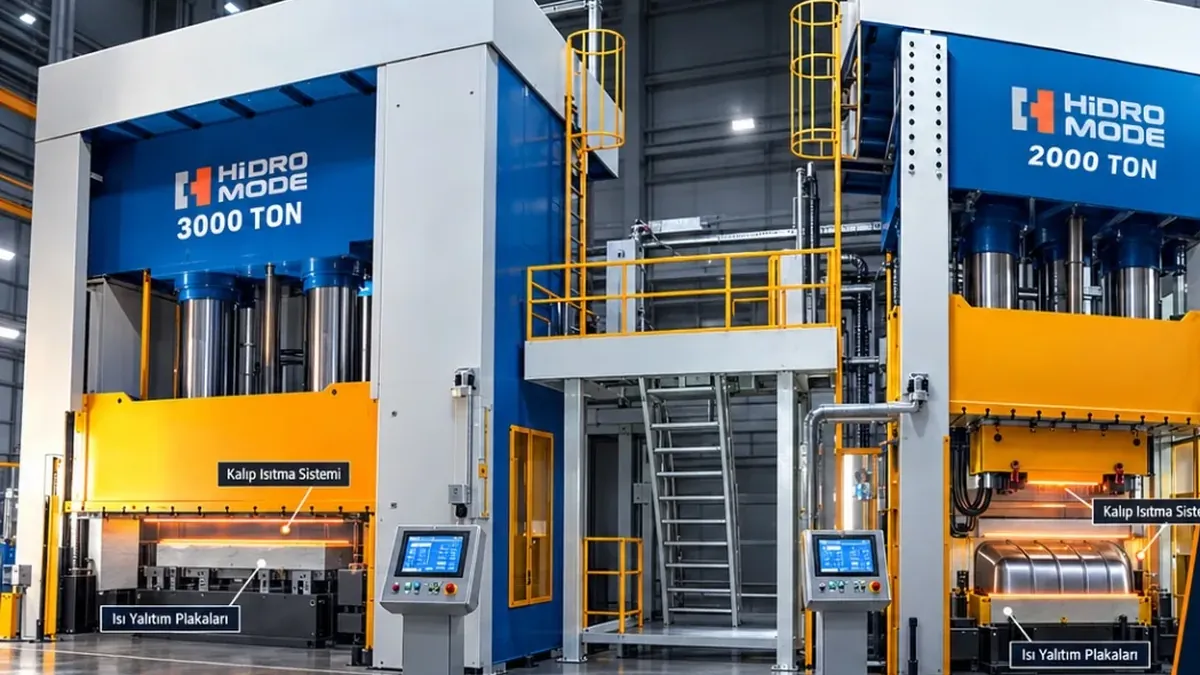
Hidromode composite presses with active parallelism are designed for this need in the 2,000–3,000-ton class and can also be added to suitable existing presses through retrofit.
Frequently Asked Questions
Does parallelism control lengthen cycle time?
No. Correction happens instantly during pressing with no meaningful effect on cycle time — overall output rises as scrap falls.
Does every composite press need active parallelism?
For small, symmetrical moulds frame rigidity may suffice; it is recommended for large, off-centre or tight-tolerance parts.
Can parallelism control be added to an existing press?
Yes, through a retrofit project if the frame and bolster design are suitable.
Our engineers will help you with press selection, capacity and automation.